MODE Weekly
From 1990-2003 this was the website for MODE Weekly which offered Cool Stuff About Business and Entertainment in the Greater Harrisburg, PA Area.
Content is from the site's 1996 archived pages providing a glimpse of what MODE Weekly offered its readership..
Harrisburg, Pennsylvania's online News, Opinion, Arts and Entertainment information archive, serving the PA Capital Region.
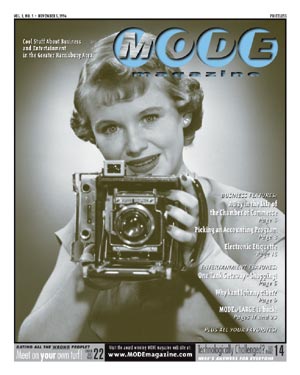
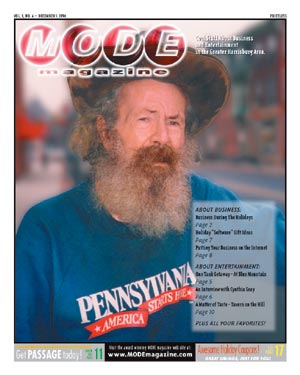
July 1996 - Vol. 1, No. 1
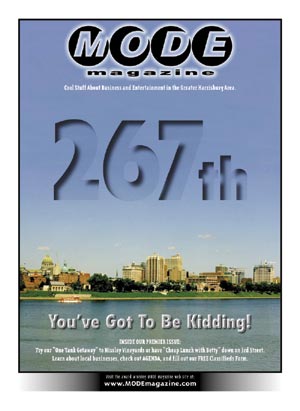
About Our Premier Issue’s Cover
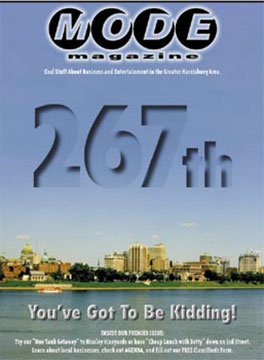
Recently a prominent "money" magazine rated Harrisburg, PA 267th out of the top 300 cities to live in, in the United States.
That’s fine if you a) live in a city rated above 267, or b) you don’t care.
We at MODE decided a) because we did live in a city rated 267, and b) we did care, that this article was unfair to the city of Harrisburg, and downright insulting to the people who choose to live here. We believe this to be so true that we dedicated our premier issue’s cover to topic.
First and most disconcerting is the fact that the folks rating these 300 cities only visited the top 10 and bottom 5 , leaving 285 cities to be rated on statistical data and subjective opinion only. That’s fair. Second, why in the world rate 300 cities. Because you have statistical data for 300? Wouldn’t you agree that rating the top 100 cities would make more sense? By rating 300 cities, it appears to me that this "money" magazine is sending a message to its readers that the bottom 150 cities are places you probably don’t want to live. If you were looking over this list, would you consider the bottom cities?
As relative newcomers to Harrisburg, We’re proud of our decision to move here. Would we have moved if we had read this "money" magazine’s article? Of course, but because we visited Harrisburg several times and discovered how wonderful the people are and what great things the city has to offer. How many other cities do you know of that own their own baseball team?
We believe Harrisburg, PA should NOT be included in any further surveys or lists published by this "money" magazine. If you feel the same, tell them! Harrisburg is a wonderful city, as are many that probably came in at the bottom of that list. Until that magazine visits each and every city before they pass judgment all we can say is: 267th, Are You Kidding!
We urge you to read this article yourself. You’ll have to go to the library or borrow a friend’s because the July issue is on longer on the newsstands. But, as of the printing of this issue, the above internet address will take you directly to the Harrisburg, PA page within the "money" magazine’s web site. (They make it simple to browse their site, don’t they?)
Originally published: July, 1996
~~~
My world: When I had to pack up my elderly father's belongings and move him to this senior residence in Bel Air Maryland where I live, there was one box that he insisted I make sure was included was filled with all his saved issues of MODE Weekly. But Dad, I protested, these are at least a decade old. It didn't matter, he said that he enjoyed rereading the issues and they would be a comfort now that he was moving away from PA. I was so thankful I was able to find him a spot in Hart Heritage Estates, at their Forest Hill assisted living facility. It would make it much easier for me to check up on him, and gave me peace of mind knowing he was being well cared for. Several week after he made the transition to this home for seniors, there I was in his room, looking at the October 1996 back issue of MODE Weekly with him. He was reminiscing about the 1996 Strawberry Ball (see the article below) that he and my mother attended. I was amazed how he could recall their costumes- all the details down to their red high top sneakers, about the casino that ran the length of the Square, how he and my mother won and used their "play" money to buy gift certificates from local merchants, and the great cover band, Class Act, featuring Rita, that played all night.
~~~
THIS MONTH'S FEATURES

What’s Your Favorite Pastime?
Have you ever gotten goosebumps listening to someone sing? That happened to me last night. My wife and I stopped by Skyline Studios (one of our charter advertisers) to work on a radio commercial and, for the first time, got to hear a true 5-part street-style a acapella doo-wop group sing. Pastime is Gordy Geesey, Jr., Donnie Schwanger, Ron Horner, Bill Healis, and Buddy Scharff (l-r). Pastime is a street-style doo-wop group that focuses on harmony and blend as their forte. Pastime is excellent.
Gloria and I listened briefly as the group wrapped up another song for their soon to be released CD, as yet untitled. Donnie, the group’s founder, told me that they have no original songs. Everything they do are covers from the early 50’s to the mid 60’s, and everything they do sounds terrific. It was immediately clear that making a CD was the right move for this group. The CD will have an anticipated 20 to 22 songs on it, and is slated for a September release. (Check with the MODE office for availablility.)
Three key factors influence why Pastime sounds so great: 1) the member’s dedication to the "street-style" doo-wop sound, 2) their ability to harmonize naturally, and 3) the almost perfect blend of their voices. Buddy Scharff, the group’s vocal coach, told me that there are essentially two types of doo-wop groups from the 50’s, the barbershop style and the street-style. Barbershop style groups are always made up of four members, each scoring and arranging their singing separately. Street-style groups usually have five members, never score or arrange anything and commonly change singing parts according to which member can "hit the note". (NOTE: three of the five members can’t read sheet music, yet still sing powerfully). So a street-style group learns a song by singing and resinging until it’s right.
Harmonizing doesn’t come naturally, and more considerably to an a capella group. Pastime’s ability to make the music flow is outstanding. Buddy Scharff explains: "In street-style harmonizing there are three parts, one high, one low, and one in the middle. What makes Pastime sound so great is that we have an additional high (the 1st Tenor) and an additional low (the Bass)." It took practicing 3-4 times a week, 4 hours a night non-stop to memorize the 40 songs Pastime sings.
Listening to Pastime can be a profound experience if you close your eyes. Their perfect blend of singing creates the sensation that there are many more vocalists than just the five guys. For Pastime, their blend, or their ability to adjust their volume, intensity, projection and to match every vowel exactly, is what makes them so unique. Listening with your eyes closed is a truly wonderful experience. (It gave me goosebumps). When the group was finished with their recording session, they gave my wife and me a brief performance. Pastime sang Have You Heard, originally by the Duprees, and Diamonds and Pearls, originally by the Paradons. It was fantastic and no words on this page can describe the experience. It sounded like a chorus of singers filling the room from end to end.
If you’ve never enjoyed hearing an a capella group sing, I strongly recommend that you stop up to Circle G on Route 322, Saturday, July 27th for one of Pastime’s few local performances. You can also catch Pastime in Philly on an almost regular basis.
Good luck to Pastime on their CD project, and thanks for recording MODE’s radio jingle, we love it!
+++++
Why should I care about advertising on the Internet?
You should care about everything that affects your business. The Internet is truly in the spotlight right now, but it’s definitely not new. The Internet has been around since the early sixties, and all along has been used for information exchange between universities and governments. Just recently has "big business" realized the potential of advertising on the Internet. Commerce via the Internet is global yet affordable. Imagine that. You should care about advertising on the Internet because your business, however big or small, can reach the entire world, 24 hours a day, 365 days a year.
A small investment can go a long way. Depending on who you work with to do your Internet advertising, you could pay as little as nothing to get on the Internet. (We offer free Internet ads!) The key to advertising on the Internet is finding the right people to advertise with. The right people will tell you honestly if the Internet is an advertising avenue you should explore. They will evaluate your business and offer you affordable advertising options. They can give you statistics regarding the number of people that view your ads, and show you ways to make those statistics turn into profits. But BE CAREFUL, there are a lot of sharks out there just waiting to rip you off.
Done right, it can be HUGE. Look before you leap. The Internet will be there tomorrow, and there is no rush. Ask a lot of questions before you chose a company to put you on the Internet. Tell them you have three primary goals, and ask them how they will address them. Your first goal is to have as many people, "Net surfers" visit your Internet site as possible each day. Your second goal is to show your product or service in a way that is informative and exciting, yet fast. Your final goal is to get the "surfer" to respond to your ad, either by asking for more information or by actually buying something. They should be impressed, and able to address each goal readily and in plain english.
If it’s FREE, take it! This is our shameless self-promotion. Advertise in the print edition of MODE, and we’ll put your exact same ad on the Internet for FREE! We’ve decided to do this because we value our advertisers’ business and believe they deserve a chance to experience advertising on the Internet with NO RISK. If our advertisers find success, BRAVO. If they don’t , well no harm done. So call MODE today, and find out how you can advertise on the Internet for FREE. Only from your friends at MODE!
+++++
Top 10 Reasons Why You Should Always Advertise!
- 1. Your market is constantly changing.
2. People forget fast.
3. Your competition isn’t quitting.
4. Advertising strengthens your identity.
5. Advertising is essential to survival and growth.
6. Advertising enables you to hold on to your existing customers.
We all rely, in part, on repeat business and referrals. Old customers are the key to both. When old customers don’t hear about you, or directly from you, they tend to move on. Cutting your advertising is a negative signal to those who actively patronize you.
- 7. Advertising maintains morale.
8. Advertising gives you an advantage over competitors who have ceased advertising.
9. Advertising allows your business to continue operating.
You will always have overhead; bills, telephone, rent/equipment, your time. Advertising creates the AIR overhead breathes! Advertising is the portion of your business responsibilities that rejuvenates and draws new life (revenue) into the process.
- 10. You have invested money that you stand to lose.
If you stop advertising, everything you’ve invested becomes lost, as the consumer’s awareness you’ve purchased slowly dwindles away. Sure you can buy it again, but you’ll have to start from scratch.
TRY THIS EXERCISE
Organize. Take inventory of the advertising you do right now. Spend a few minutes with paper and pencil and write down all of the advertising you’ve done for your business (that you can remember) in the past year. If you keep records, kudos for you.
Evaluate. What do you personally feel was successful. Where do you think you went right, and where do you think you spent wrong? Measuring subjectively, no matter what the salesperson tells you, can often point you in the right direction. If it just didn’t feel right, it probably wasn’t.
Apply. Cut the fat. If it was stupid or didn’t work, forget it. Rely on the things that you know were and are successful. What was the best advertising you ever did? How can you duplicate that advertising more effectively, and at a lower cost? If you put your mind to it, advertising can be a powerful tool for you and your business, instead of a painful irritating experience.
Finally, plan ahead. Plan your advertising calendar 3 months in advance. No arguments. If department stores can put the Christmas decorations up the day after Halloween, and income tax services can offer refunds the day after New Year’s, you can plan 90 days into the future. Remember: If they need an answer by morning, the answer is: PASS!
+++++
MODE wins Microsoft award
Just as this premier (print) edition of MODE was being wrapped up, we received a very special and prestigious award via E-mail. Microsoft Corporation (the 800 lb. software gorilla) named MODE to their Ultimate Web Site list.
Microsoft surfs the web in search of web sites that take advantage of Microsoft Internet Explorer tags (commands) vs. Netscape Navigator tags (the popular favorite). We chose MSIE over Netscape because of it’s ease of use for the novice, and it’s extended multimedia support. MSIE 3.0 plays music, video and animation right from Windows 95, no plug-ins, no helper apps. It’s great and well worth downloading (for FREE).
We’re happy to to be named by Microsoft, but it’s you, our readers, that we want to hear from.
September 1996 - Vol. 1, No. 3
Random Thoughts
Has everyone read the book: All I Really Need To Know I Learned In Kindergarten, by Robert Fulghum? If you haven’t, you should. If you have, read it again, it’s better the second time around.
Why is it so hard to be nice to other people?
Don’t you hate when you’re expecting an answering machine, and the actual human being picks up instead. I made a phone call the other night of a type I rarely make. It was to my competition. It turned out to be a great call though, and it taught me a valuable lesson.
It was, oh about 10:30 at night. One of the other publications here in Harrisburg recently put out their latest edition. It was fantastic. Clean. Crisp. Excellent use of color and imagery. I was impressed. I picked up the phone, (remember it’s 10:30pm) and called the Publisher’s number. On the third ring (AAARRRGGG!!!) someone answered the phone. I froze. It’s 10:30 at night, what kind of person is still at work at 10:30pm? I was hoping to get the answering machine, and to leave a nice complimentary message... BUT NOOOOOO, someone answered the phone instead.
And guess who answered the phone... at 10:30 at night? The Publisher, of course. Working away. I laughed a little and thought "Birds of a feather."
So I said hello, introduced myself and went on to have a terrific conversation with a person that is as in love with Harrisburg as I am. A person who is publishing for the people; for the community.
I wanted to share this story with you becasue it’s a good example of getting more than you planned for, and feeling great about doing it afterwards. I wanted to leave a message on an answering machine, and now I have a new friend. To my new friend, thank you for taking the time to talk to me the other night. If there is ever anything I can do for you, please call... even as late as 10:30pm.
P.S. The lesson I learned that night: It’s not that hard to be nice.
Next topic.
Let’s talk for a moment about my astounding lack of knowledge in the area of Jazz. In this issue you will find several articles about Jazz. I wrote them all. I should have written NONE of them. I should have found a great Jazz lover and paid them handsomely to write these articles. But alas, I wanted to learn something about Jazz, so off I went in search of Jazz in Harrisburg.
Interestingly, I learned a great deal about Jazz, yet barely scratched the surface. A contradiction? Not really. I am a novice and wrote these articles as I would want to share my newly found knowledge at the cafeteria lunch table, with other people who are novices. (If you know a lot about Jazz, especially in Harrisburg, try not to laugh TOO loud as you browse the pages.) My true intention in presenting Jazz in this issue is one of an introductory nature. I know very little about Jazz, but I do know that it’s here in Harrisburg. I know that many people love and support it, and I know that Jazz is something that needs to be shared.
So, in the interest of sharing, (remember: it’s nice to be nice) I tried to find out the who, what, when, where and why of Jazz in Harrisburg. Once I had a good idea about it, I would neatly write it up and present it to you the readers. Except for one thing. Every person I talked to about Jazz referred me to three more people. When I tell you that I barely scratched the surface, I mean it. So in fairness to all the people I did not get to talk to, we at MODE are going to try to launch a monthly Jazz column. I‘ve got my fingers and my toes crossed.
I know I’m gonna need help, so let’s hear from you Jazz types.
Thanks again for reading, and have a great month!
Scot Giambalvo, Publisher
THIS MONTH'S FEATURES
Introduction to the Friends of Jazz
This weekend I did four great things, related to Jazz, that I strongly suggest you do if you want to know more about Jazz in Harrisburg.
First, I went to the Hilton Saturday night to listen to the smooth Jazz sounds of Steve Rudolph, one of the founding fathers of the Central Pennsylvania Friends of Jazz (CPFJ) organization.
Playing with Steve were Shelia Cooper, New York based alto saxophonist and vocalist, and Andy Middleton, tenor and soprano saxophonist. The music was vibrant and alive. I can recommend no better place to melt into the atmosphere and soak up the Jazz
Second, from Steve, I got a copy of Steve’s new CD, which has been playing nonstop in our office, and is absolutely fantastic. It features 10 tracks ranging from Steve’s melodic piano solos to harmonies with Dwayne Dolphin, Roger Humphries and Steve Varner. It is a rare treasure to own a CD of such great quality, and be able to hear the artist perform live in your backyard.
Third, I met with Dave Lazorcik, Executive Director of CPFJ, who took the time to answer some questions about the organization, its origins, purpose, and future.
Founded in 1980 by Steve Rudolph, Jack Snavely, Russ Neff and Lee Swartz, the CPFJ is a non-profit organization with three very focused goals: promote, preserve, and present Jazz in Central Pennsylvania. Built from the desire to see Jazz grow in Harrisburg, and thus ease the burden of having to travel to the "big" cities to see the Jazz greats, The Central Pennsylvania Friends of Jazz brought Jazz from a predominantly black following to a mainstream appeal that everyone in the area could enjoy. It is safe to say that CPFJ bridged the gap and has been bringing top Jazz artists of all kinds to Central Pennsylvania for 16 years.
Although CPFJ is well known for its promotion of concerts, Jazz walks, and Jazz festivals, there is much more to the organization. I was excited to learn that CPFJ follows it’s agenda of preserving Jazz by supporting High School Jazz programs in Central Pennsylvania. The CPFJ Youth Program brings local and national artists to the schools. Clinics are held where students can work with and learn from well known Jazz performers. The CPFJ also gives a yearly Jazz Scholarship for students going to college for Jazz study.
I was also pleased to learn that the success of CPFJ is heavily based on the contributions of it’s members. For 16 years they have orchestrated Jazz in Central Pennsylvania with an all volunteer staff. Every event, concert and performance is managed by volunteers.
It is also very apparent that CPFJ knows how to communicate with its members. The monthly newsletter is packed with information ranging from listings of major events and concerts, to youth committee notes, a monthly calendar of local Jazz nightspots, editorial regarding current Jazz happenings, and even a membership application.
I mention the application because it is important to convey the fact that this is a non-profit organization and it does desperately need support. Membership is as low as $8.00 for students who will then receive half-priced concert admission and the monthly newsletter, and $18.00 for a regular membership which offers discount concert, festival and picnic admission as well as the monthly newsletter. There are increasing levels with greater benefits.
Fourth, from Dave, I got a copy of the book: Discover The Central Pennsylvania Friends of Jazz, by Paul E. Beers.
If you don’t have a pretty good idea of what the CPFJ does, this book is the definitive outline. Remarkable in its detail and thoroughness, the author Paul Beers is a 45 year journalist-historian and former Patriot-News columnist and associate editor of 25 years.
In this book you will find a chronicle of the origins of the Central Pennsylvania Friends of Jazz, as well as the history of Jazz as it pertains to the Harrisburg area, and a detailed 8 year synopsis of the growth and contributions of CPFJ.
If you like Jazz, and you’re not already a member of CPFJ, it would serve you well to join in the local support of Jazz.
+++
So, What is happening to Jazz in Harrisburg?
This question keeps popping up in my travels... What’s happening to Jazz in Harrisburg?
Well, on the one hand, you’ve got a select group of people who believe that the Central Pennsylvania Friends of Jazz is not the only game in town. But because CPFJ is so large and well known, it’s difficult to get any other Jazz events going. The major block other Jazz promoters in the area hit when making proposals to local venues is the: "Well, if the CPFJ haven’t done it, it probably isn’t worth doing." This coupled with the basic belief by most venue owners that Jazz crowds aren’t big spenders makes them shy away from anything less than a guaranteed success.
So, on the other hand, how do you explain the list to the right. This list is far from complete, and we at MODE hope to hear from the other area venues that are supporting Jazz on regular nights. When we set out to find Jazz in Harrisburg, we often heard: "There isn’t much to speak of." Yet, aside from the established, Mecca of Jazz like the St. Moritz and Lawson’s of days gone by, we managed to find out that Scotts’ Bar & Grille had live Jazz on Wednesdays, Heaven had live Jazz on Thursdays, the Bar at the Hilton has almost always had Jazz, and Kosta’s has a truly great Jazz Brunch every Sunday. This doesn’t even cover the venues we couldn’t confirm before the printing of this article.
So Jazz is alive and well in Harrisburg. In part thanks to efforts of Central Pennsylvania Friends of Jazz to keep Jazz a mainstream mainstay for the local population. The new radio satellite feed of Temple Jazz, from Temple University has also kept Jazz somewhat in the limelight.
But what of the club owners that just don’t want to support Jazz because it apparently doesn’t want to support their efforts in the form of revenue?
I have learned one very important thing about Jazz. It is an interactive art form, truly American, and always growing. Born from Blues and Gospel, Jazz is the voice and soul of the artist. How the artist feels and what the artist is experiencing is conveyed, often quite clearly, in the music being played. In live Jazz performances, the audience is a key factor in the mood and performance of the artist, moreso than in any other improvisational musical art form.
Diane Wilson, a Jazz vocalist, and Rick ‘Ricci Rags’ Ranaglia, Jr., a Jazz saxophonist both confirmed that they feed on the reaction and interaction of the audiences they are playing to. Owner of the St. Moritz, and long time piano player Mack Granderson commented: "if you like Jazz, you’ve got to come out and show your support. Frequent the places that have live Jazz and tell the management what you like and dislike. It’s the only way to gauge the success and possible continued support of the Jazz artist."
Ricci Rags added: "Jazz isn’t a fad, you don’t have to dress up or dress down to it, you just have to enjoy it for what it is... Jazz"
It is apparent, for reasons yet unknown that more and more local (Harrisburg) clubs (venues) are supporting Jazz in one way or another. If you want to hear live Jazz at your favorite watering hole, you have to ASK FOR IT! For now, patronize the places listed to the right, they are answering your requests for Jazz right now.
Please look for a continuation of "Jazz in Harrisburg" information and interviews in future issues of MODE.
October 1996 - Vol. 1, No. 4
THIS MONTH'S FEATURES
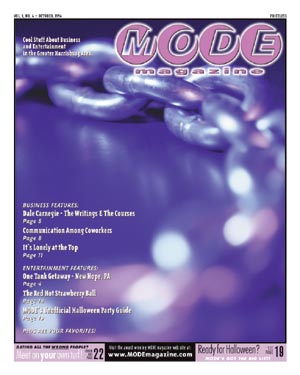
The Strawberry Ball, 1996
The Strawberry Ball is coming! The Strawberry Ball is coming! That’s about all you’ll hear coming from Jan Proceed these days. Jan, co-founder of the Backyard Bash, (it’s his backyard) is gearing up for yet another cool party creation. This premier Strawberry Ball is being held by The Greater Harrisburg Arts Council and Backyard Benefits, Inc., on Friday, October 25th, 1996, and proceeds go to Delta Housing and GHAC.
The First Annual Red Hot Strawberry Ball will be held in the Strawberry Square Atrium (of course), at the corner of Third and Walnut streets. But don’t be fooled, they’ve got the whole mall, upper and lower level. Tim Burns, long-time WINK 104 morning personality will be the Master of Ceremonies, and Alicia Richards, WHTM Channel 27’s news anchorperson will be the honorary costume contest judge. Doors open at 8:00 pm and everyone — singles, couples, and groups are invited to attend. In addition to the party, live entertainment, and costume contest, you’ll find a real casino strip, hors d’ oeuvres, a cash bar, and even a silent auction!
The Strawberry Ball is a traditional costume party, so be prepared to come in disguise. If you aren’t, make sure you’re wearing red, or you’ll surely stick out like a sore (blue) thumb. The live entertainment is provided by Class Act, featuring Rita. Class Act is recognized in Harrisburg as one of the great cover bands performing everything from classics to contemporary. They are sure to get the house rockin’.
Awards for the best costumes will be given in several categories, and the spoils look to be great! Forget Las Vegas and Atlantic City, because the Red Hot Strawberry Ball has a real casino running the length of the Square. Gamble to your heart’s content with "Strawberry Ball cash", and if you clean up at the tables, you can use your PLAY cash to buy REAL arts, crafts, and collectibles, as well as gift certificates from local merchants.
If that isn’t enough, the Ball is also hosting a very impressive silent auction. It’s the perfect chance to pick up great items, donated by local artists and businesses, at great prices. Plus it’s also a lot of fun bidding in secret!
Admission to the Red Hot Strawberry Ball is just $10 per person in advance, and $15 per person at the door. Availability is limited to 2,000 attendees, and you better bet it will be a sell out. If you would like to get tickets in advance, (strongly recommended) call the Greater Harrisburg Arts Council at 238-5180. (NOTE: This information is from 1996!
Special room rates are available at the Hilton, if you want to make a night of it, and you don’t even have to worry about parking because attendees are welcome to park in the Walnut Street Garage absolutely free.
Make that call today and get your tickets while they’re RED HOT!
November 1996 - Vol. 1, No. 5
Please, please, not another salad...PLEASE!
Please, please, not another salad...PLEASE!
Greetings from behind the big metal desk with the big old monitor.
Welcome to issue number five. I’m very proud of this issue because it features the first of many "A Day In the Life Of…" columns. In this department, we hope to show you the day-to-day operations of local businesses, how much work really goes on, and how they impact the community. Since the Capital Region Business Fair is the 20th and 21st of this month at the Farm Show Complex, what better organization to spotlight for our premier column than the Capital Region Chamber of Commerce. It’s an informative article, I hope you read it.
How ‘bout that cover? Neat huh? A little retro maybe? A LOT RETRO MAYBE. Nevertheless, it is a tribute to a comment, based on an omission of department, pioneered by a man in Virginia. How’s that for complicated. Here goes. Because of space limitations, I had to pull our MODE@LARGE photo section last month. (This is the section where we go around to local businesses take pictures of staff and patrons and put them in the paper.) The idea for this "photo gallery" section was the brain-child of Jeffrey Lefcoe, publisher of FLASH Magazine in Virginia Beach, VA, for whom I worked. Down there, it is one of the most eagerly scanned sections of the paper, (everybody wants to see if they’re in it). Well, I really didn’t know how popular it had become up here until I pulled it last month. I received some comments as to the value of the section and the empty void left by it’s omission. One such comment is in our new Letters section. So the cover is a picture of our MODE@LARGE photographer holding our new Kodak digital camera, (chuckle suppressed.) A section we will try to never omit again.
I don’t promise that you will see a letters section every month either, but I’ve received enough e-mails and notes this month to publish a few, so here they are. We’ve answered the ones that we felt necessary.
If you haven’t noticed, MODE magazine doesn’t come out on the first of the month. As a matter of fact, we come out officially (as of this issue) from the 5th to the 5th of every month. This was a mutual decision by the staff, born of necessity. The reason is two fold. First, it has been a challenge to get calendar information for AGENDA in a timely fashion. It was our feeling that it was a greater benefit to the reader to wait (and badger calendar providers) for their dates and information than to just omit them because they’re slow. Most of those folk get their info to us on the last day of the month. Second, it is far easier to schedule a print date just after the 1st, than just before it. Comments can be directed to the Publisher, objections will be forwarded to the sluggish calendar providers.
Please do come check out the MODE magazine ONLINE booth at the Capital Region Business Fair on November 20th and 21st. We’ll be showing off MODE’s (finally complete) Internet web site, some really cool new technology, and we’ll be giving away FREE Internet accounts! We’re booth #178, write it down.
MODE magazine is having a little "Meet the Staff" introduction party on Thursday, December 5th. It’s a semi-open affair, so if you’d like to invite yourself, please contact us before December 1st. (Party crashers will be forced to listen to me talk about computers all night.)
Thanks for reading MODE.
Scot Giambalvo, Publisher
P.S. Yes, the titles of my "diet" column every month are directly related to cheap lines from a very cool cult movie. Can you name it? (Hint: My grandfather used to read the book to me when I was sick.)
THIS MONTH'S FEATURES
What you hear is the sound of Ultimate Suffering
Publisher’s Note: This feature is an ongoing monthly progress report on the Publisher’s battle with obesity. Back issues of this column are available at the MODE magazine main offices.
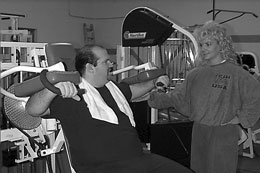
Well here we are in month two, and I can only say… I hate it, I hate it, I hate it. I had no idea how much I had really grown attached to my eating habits. I must admit, I feel better physically than I have in years, but some weird part of me still wants to sit down in the candy isle and gorge. I have lost approximately 10 pounds in the first month. How much does 10 pounds equate out to a man weighing in at 318? Well, I’ve lost an inch around my neck, shoulders, arms, and waist. I’ve lost 2 inches around my chest, ribs and mid-section. Actually, I’ve lost a total of 13-1/2 inches of my personal 3-D space. That made 10 pounds seem triumphant
First, I want to tell you how incredibly professional and supportive Physicians Weight Loss Center has been, and then I want to tell you how grueling and demanding Woody"s Workout Club can be.
Physicians Weight Loss (PWLC) is impressively thoroughly, and even more so, very patient. There is so much I have done in the first month that I want to introduce you to each part in this month’s feature and then explain them in detail over the next 5 articles. First I went through an evaluation where we mutually agreed that I was overweight. According to the body-type charts, I should weigh between 165 and 195 pounds. (I haven’t weighed 165 pounds since 9th grade). I’ve set my goal for 215 pounds, or approximately 100 pounds of weight loss. At the evaluation the (PWLC) nurse also did a body measurement. I occupied a lot of space. 420-1/2 total inches to be exact. Also at the evaluation I was introduce to the diet (I would come to loath) that I would be on for the duration of the program. 1200 calories a day, normal foods, accompanied by several protein, vitamin, and calcium supplements a day, that ensure loss of fat and not muscle.
For my first two weeks of the program I had to visit the center every weekday. This keeps you honest. It also lets the PWLC folk know if anything isn’t right. Thereafter, it’s 3 visits a week. During those first two weeks, the nurse introduced me to the Slim Within Personal Assessment System (exclusive to PWLC), which is used to pinpoint psychological blocks or hurdles that need to be overcome before permanent weight loss can be achieved. I filled in a questionnaire that will reveal my personal attitude toward my weight, as well as negative thought that may have kept me from succeeding on previous diets. Also in those first two weeks, PWLC did a body composition analysis, where they hooked me up to a machine with EKG-like sticky pads. The result of that analysis was… I have a pretty rubbery body composition. Actually my lean-to-fat ratio is 1-to-3, where it should be 3-to-1. Bummer. This confirmed my body lean content of 57% versus my body fat content of 43%. But the analysis also indicated that my basal metabolism is 2,374 calories a day. That means that sitting around watching cartoons for a full Saturday, it would still take 2,374 calories to keep me running. On a 1200 calorie a day diet, I am assured to lose weight.
Unless I cheat. Arrrrrrrg!!! I will admit right now that I have been a bad boy. Despite my spouse’s attempts to circumvent my bad habits, I have binged at least once and sneaked Smartfood popcorn at least… well, more than once. And yes, I plan to bring the Smartfood popcorn bag to PWLC so they can tell me how REALLY bad that stuff is for me.
My first day at Woody’s Workout Club (as it is for any new member) consisted of an explanation of the club’s policies, a brief tour, and a personal goals assessment, which the trainer turned into a pretty vigorous workout. I kid about grueling and demanding, but your workout is what you make it, and remember, no pain, no gain. So here’s an outline of my "beginner’s" workout. I warm up with 10 minutes of walking on a motorized treadmill, followed by 20 minutes of cycling on a recumbent bicycle with a heart monitor. A lot more effort can be put into this type of cycling with a lot less stress on the body. My goal was to reach my target heart rate for all 20 minutes. After breaking an unnatural sweat, I proceed to the Nautilus Circuit Training room. The circuit training consisted of performing 15 repetitions of 18 exercises on about a dozen machines. The goal of circuit training (for me) is to lose weight. This is accomplished by increasing the number of sets of 15 repetitions I do, to three of each exercise, while gradually increasing the weight. Circuit training offers the precise targeting of muscle groups with range of motion control and predefined incremental weight increases. The "machines" (as opposed to free weights) are easier for the novice.
Woody’s Workout offers much, much more than I have outlined here, but this is all I would agree to for this (truly out of shape) body. I sincerely plan to increase my workout from this 45 minute program, but I cannot honestly see my self going from no exercise to being the workout wonderboy. So for now, it’s three visits a week to Woody’s and one morning a week on that NordicTrack I bought and never use.
To sum things up for my first month… it ain’t easy. I crave cheeseburgers, three to be exact, and that’s my problem. Physicians Weight Loss and I have determined my three weakest areas. I have a "portion control" problem, a "stress interferes with my eating habits" problem, and a serious "lack of exercise" problem. Gosh, and I though acne was a drag. Seriously though, I know what I have ahead of me, and I want to send a special thank you to everyone who has called in or written words of encouragement.
If you have a triumphant story to tell, please let me know. I will keep confidential anything that is requested of me.
More next month.
+++
Electronic Etiquette
It has been said that the electronic age has made things easier. It has also been said that as things get easier, people tend to overcompensate in the form of making those easy things more complicated. Catch 22. Human nature. Two of the most recent advances in the workplace today are electronic mail or "e-mail" and voice mail, or "stupid voice mail" (said in the tone of someone who has been pressing 3 for customer service for over an hour).
A recent business article noted that since the advent of voice mail, the number of busy signals and no-answers has gone down dramatically, but the aggravation level of the user of such systems has increased 10 fold. A very good example follows:
Call any software manufacturer’s technical support number during hours when they are closed. Several year ago it would ring and ring and ring. Today, you will probably be prompted to press 2 for end user, 3 for PC platform, 2 again for the 2mb version, then you will begin to hear the customary music on hold, and then a voice says "We’re sorry the technical support department you are trying to reach is closed. Please call back between 11:00am and 3:00pm Pacific time". Hmmm, three years ago, you didn’t get an answer. Today you could spend possibly several dollars, not to mention sifting through voice prompts, to find out they weren’t even open. Now that’s customer service.
I have two suggestions, one regarding e-mail and the other voice mail, that are arguably the best I have ever heeded.
On e-mail. If you regularly use e-mail, you probably observe this rule out of necessity. Answer each incoming e-mail (if possible) as soon as you are done reading it. The age of e-mail is still in its infancy, and if an e-mail isn’t responded to in a relatively short period of time, the sender assumes it was never received. This directly affects the sender’s confidence in e-mail as a reliable form of business or personal communication. Remember to put your return e-mail address in the body of the letter, as an attachment or signature, if your e-mail program supports it. Why? Many people print an e-mail that requires work before a response can be sent. Then they delete the e-mail, only to find out later that the printout does not have the address of the sender, only the alias and the body of the letter. Also, DO NOT use your e-mail at work for personal communications. If you didn’t know already, your company and your superiors have the legal right to inspect anything you send or receive on your computer via e-mail, and believe me, most do.
On voice mail. Please make note of the obvious when setting up your greeting(s). This applies to home answering machines as well. Phrases like "I’m not home right now", "I’m away from my desk", and "We can’t come to the phone" really don’t tell the caller anything but the obvious. Instead, use phrases like "Sorry I missed your call, but I will be back in the office around 2:00pm and will be returning calls at that time" or "I am often called away from my desk for just a few minutes, please leave a message and I should return your call within the hour". Telling people a little information gives them options, and believe me, it is appreciated. Suppose you have a customer that wants to buy product NOW. Wouldn’t you like them to know that you’re away from your desk for just a few minutes? Change your greetings daily. It is well worth it, and nothing impresses a caller more than hearing "Hello, it’s Tuesday, November 5th, and I will be out voting from 10am to 2pm, if you leave a message, I will try to call you back today, thanks". Also, if your phone system has a busy greeting option (the caller gets a special message if you’re on your phone when they call), take full advantage of it. Most people will leave a message if they know you’re in the office, and believe they will be called back in a short period of time.
Make e-mail and voice mail work to your advantage. Respond to e-mail quickly, always provide a return address, and everyone will be satisfied. Take a few minutes to answer the mental question (where will I be and when will I be back?) before recording your voice mail greeting. Record that answer in your greeting for your callers and they will be impressed. Change that greeting regularly and they will be thankful.